The Geometry of Quantum Mechanics
Hilbert Structure, Unitary Dynamics, Spin, Measurement, and the One-Particle Quantum Theory in Six-Throat Directed Spacetime
Read the original publication and reproduction archive ↗1. The Scientific Question
Can the mathematical structure of one-particle quantum mechanics emerge from the microscopic dynamics of a regular directed spacetime?
Paper XXII extends the microscopic construction established in Paper XXI, developing a continuous mathematical chain from conserved spacetime current to quantum state space, unitary evolution, observables, spin, measurement, statistical states, and low-energy quantum dynamics.
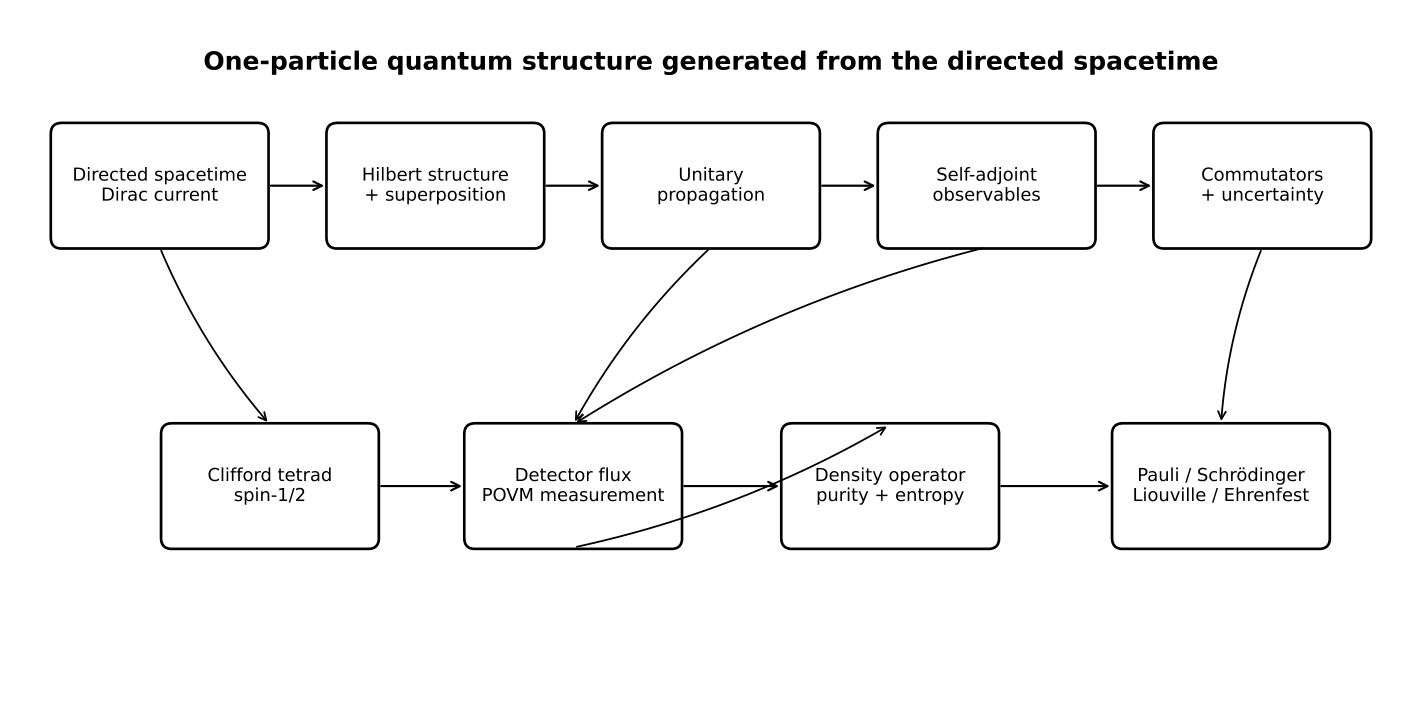
2. Hilbert Structure and Unitary Dynamics
The conserved sesquilinear Dirac current preserves the complete complex overlap structure between solutions on the same directed background.
Its associated positive, slice-independent inner product generates the Hilbert-space completion of the finite-norm solution space.
The geometric solution map preserves this inner product and satisfies unitary, composition, inverse, and adjoint closure.
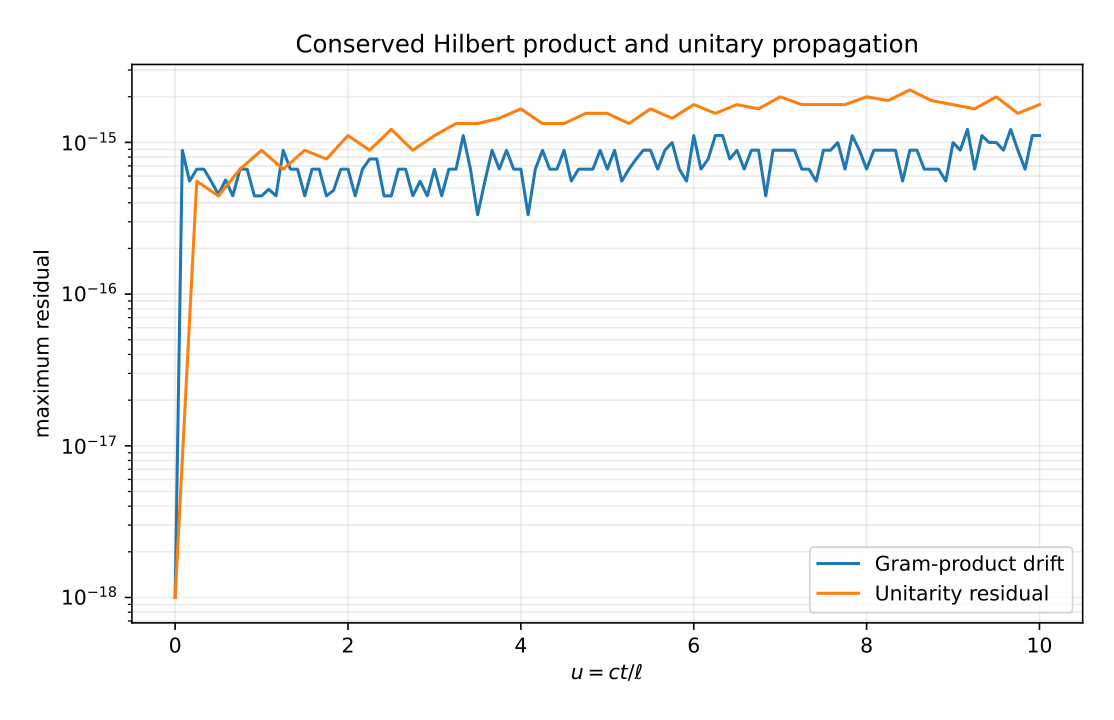
The published numerical analysis propagates eight independent complex states and a complete 48-dimensional propagator through the directed transition from positive direction to directional zero and negative direction.
The maximum Gram-product drift is 1.22 × 10⁻¹⁵, while the largest unitarity residual is 2.22 × 10⁻¹⁵.
3. Observables, Compact Geometry, and Uncertainty
Bounded linear observables with real quadratic expectation values are characterized by self-adjointness.
The construction provides real spectra, orthogonal spectral projectors, and expectation values preserved under the corresponding unitary transport.
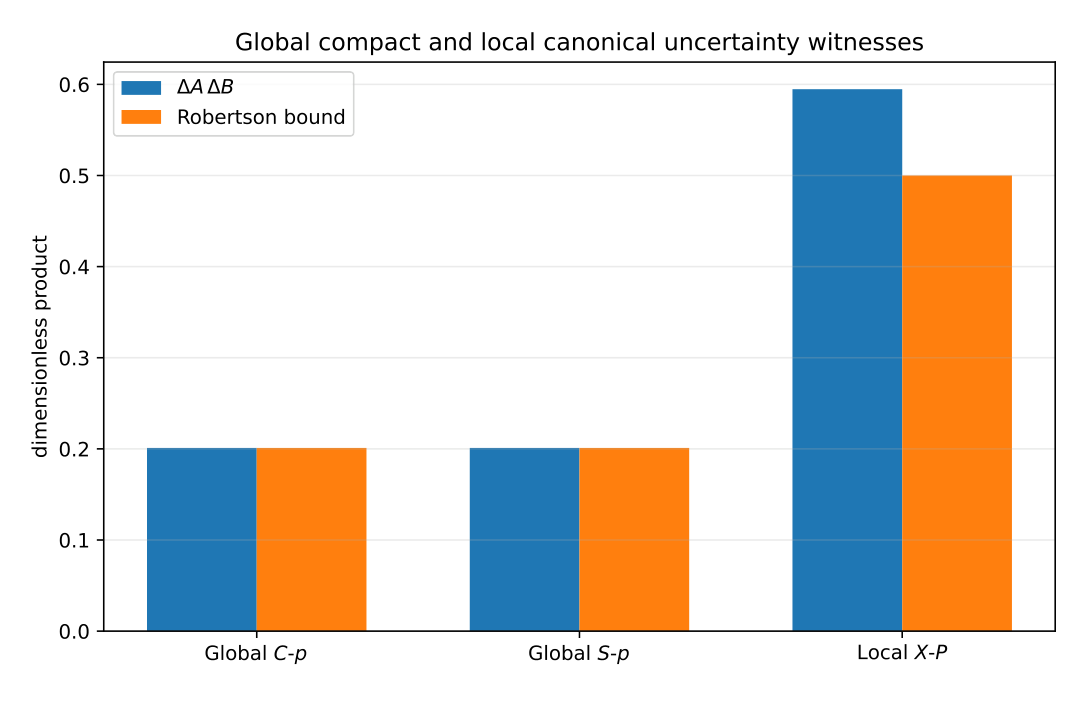
The compact global spatial cycle generates an exact periodic commutator algebra. Under the reference geometric parameterization, its dimensionless period is 15.6.
The antiperiodic spin structure excludes the zero Fourier momentum mode.
On regular local charts whose support does not intersect the periodic seam, the standard canonical position–momentum relation is recovered.
The Robertson and Schrödinger–Robertson uncertainty relations follow from the same Hilbert-space geometry.
4. Intrinsic Spin and Rotational Structure
The tetrad Clifford algebra generates the intrinsic spin-one-half representation and its corresponding angular-momentum commutators.
The spinorial rotation law yields a sign reversal after a 2π rotation and identity restoration after a 4π rotation.
The global antiperiodic spatial translation and the local spinorial rotation are compatible sign structures but remain distinct geometric operations.
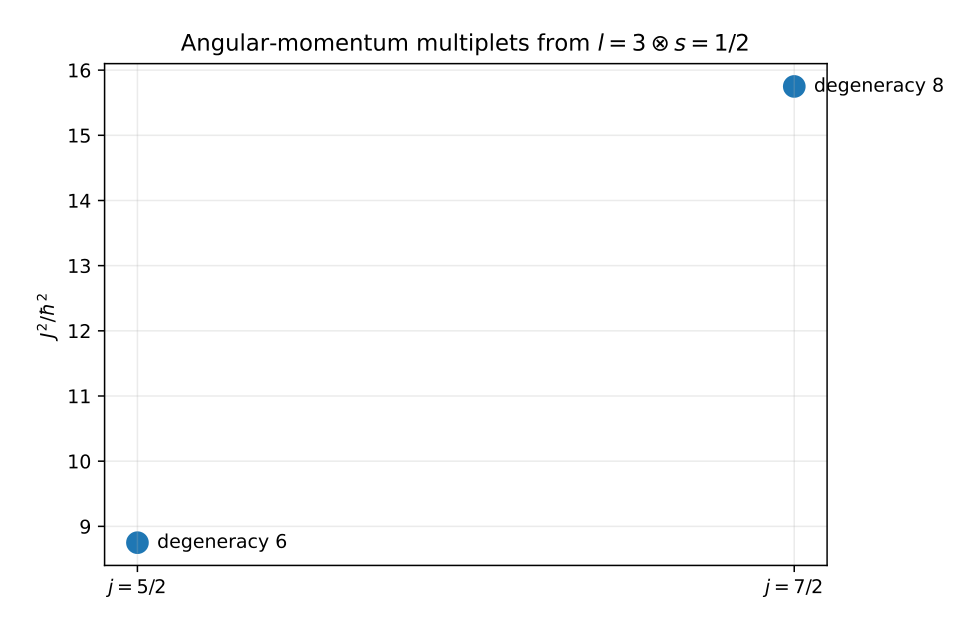
For the numerical angular-momentum construction with orbital quantum number l = 3, coupling to intrinsic spin produces two multiplets:
- j = 5/2, with degeneracy six.
- j = 7/2, with degeneracy eight.
The six-dimensional multiplet corresponds to the detector-channel structure examined in Paper XXI.
5. Detector Flux and General Quantum Measurement
The direct detector-current construction of Paper XXI is extended to positive measurement operators on the derived Hilbert space.
A complete detector partition generates a positive operator-valued measure, including a no-registration outcome when the observation window does not capture all flux.
Measurement probabilities are expressed through the trace rule.
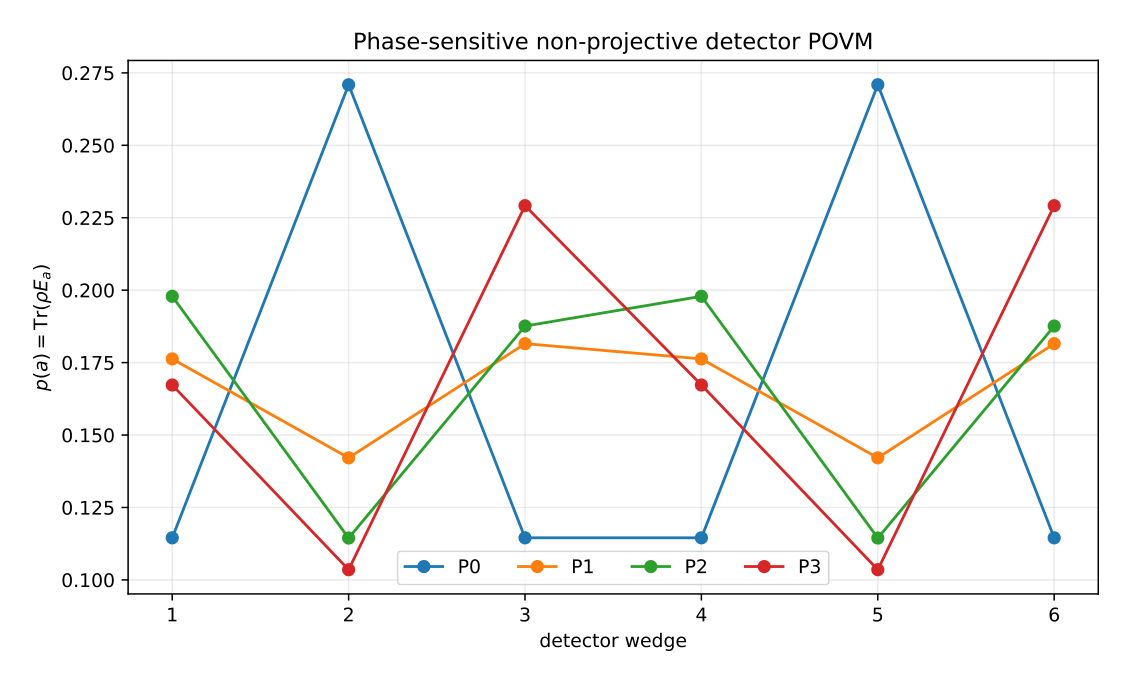
The explicit six-wedge detector construction produces a non-projective POVM whose spatial effects retain coherent phase information.
Four coherent states with identical mode populations and different phases produce a maximum wedge-probability variation of 0.16739.
In the mode-resolved limit, conditioning on detector registration recovers the geometric Born weights established in Paper XXI.
6. Density Operators and Conditional Access
The statistical-state construction represents ensembles through positive unit-trace density operators.
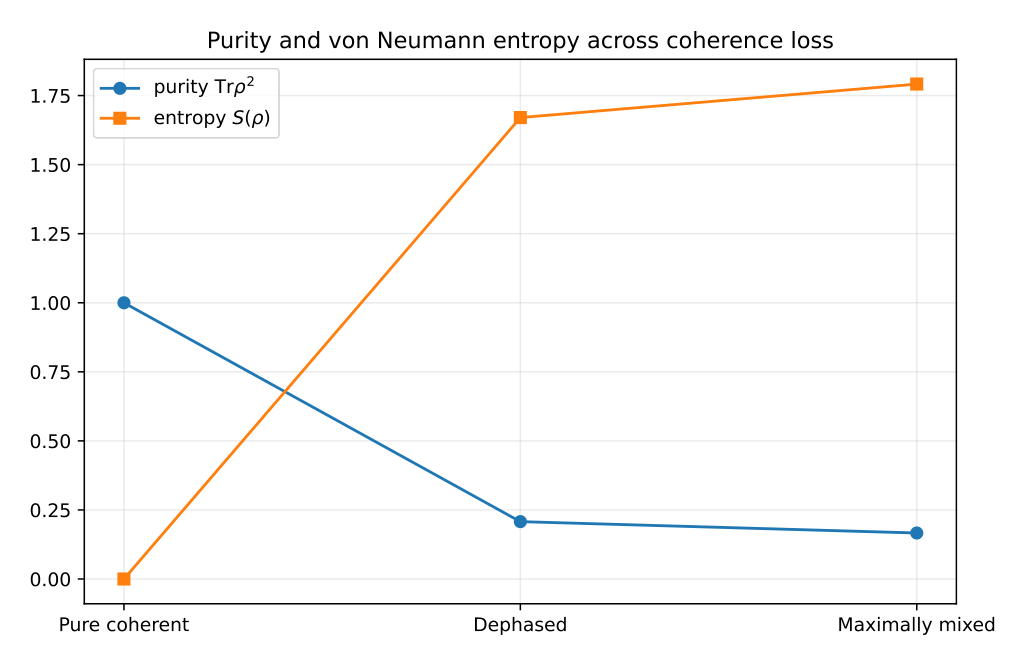
Purity and von Neumann entropy distinguish coherent, dephased, and maximally mixed states.
Unitary evolution preserves the density spectrum, purity, and entropy.
Positive square-root Kraus operators associated with the detector effects generate the measurement channel and its outcome-conditioned access states.
The conditional observer-accessible state remains distinct from the unconditioned global post-interaction state.
7. Low-Energy Quantum Dynamics
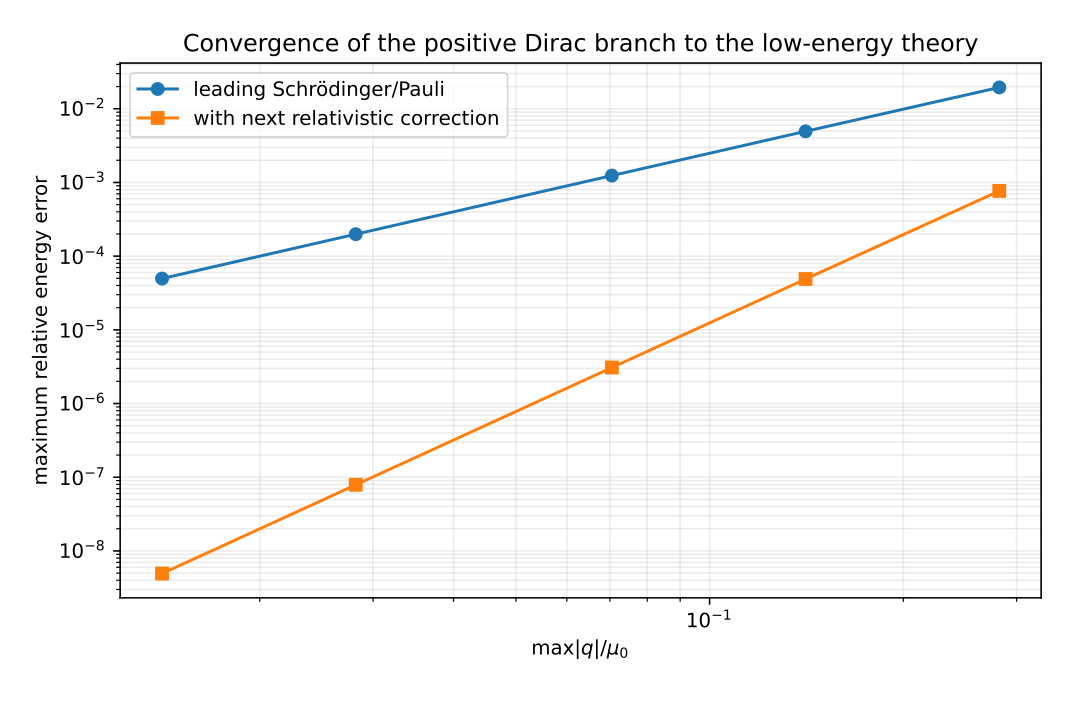
The positive-energy directed Dirac branch produces Pauli dynamics in the reference-mass limit and the Schrödinger kinetic Hamiltonian when the relevant spin-covariant momentum components commute.
The directed scalar mass also generates a geometric potential in the low-energy reduction.
For the published numerical configuration with dimensionless mass parameter μ₀ = 100, the maximum exact-Dirac versus Schrödinger wave-packet infidelity is 3.16 × 10⁻¹⁰.
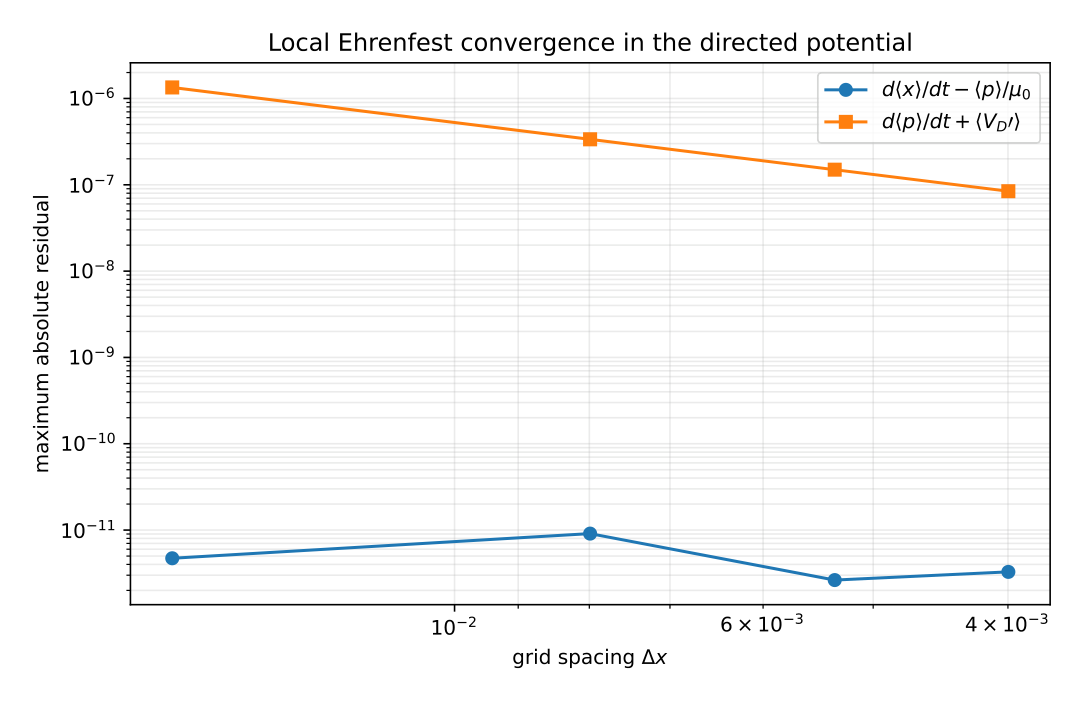
The same unitary framework generates the Liouville–von Neumann equation, the Heisenberg operator equation, and the local Ehrenfest relations.
8. Published Numerical Closure
The published forty-three-condition numerical audit satisfies all 43 declared acceptance conditions.
| Numerical examination | Published result |
|---|---|
| Maximum Gram-product drift | 1.22 × 10⁻¹⁵ |
| Maximum unitarity residual | 2.22 × 10⁻¹⁵ |
| Propagator composition residual | 1.78 × 10⁻¹⁵ |
| Inverse-adjoint residual | 1.14 × 10⁻¹⁵ |
| Global compact commutator residual | 4.41 × 10⁻¹⁵ |
| Local canonical commutator residual | 5.07 × 10⁻¹⁷ |
| POVM completeness residual | Zero at matrix precision |
| Conditional Born-weight residual | 5.55 × 10⁻¹⁷ |
| Maximum low-energy wave-packet infidelity | 3.16 × 10⁻¹⁰ |
| Schrödinger–Heisenberg expectation agreement | 5.66 × 10⁻¹⁷ |
These values are computational benchmarks obtained under the numerical configurations documented in the original publication and its reproduction materials.
9. Scientific Reproducibility
The open-publication package contains:
- The complete manuscript source.
- Eight original scientific figures.
- Published numerical result tables.
- Intermediate operator archives.
- Independent Python programs for the computational layers.
- The master reproduction driver.
- The final forty-three-condition numerical closure audit.
- Two inherited Paper XXI computational dependencies.
The master reproduction driver executes the calculation chain in dependency order.
10. Invitation to Independent Scientific Examination
Quantum physicists, mathematicians, and computational researchers are invited to examine the mathematical derivations and reconstruct the published numerical results.
Suggested examination points include:
- Conserved sesquilinear current and Hilbert-space emergence.
- Unitary propagation and observable self-adjointness.
- Global compact and local canonical commutator structures.
- Clifford spin representation and angular-momentum multiplets.
- Detector-flux POVM construction and conditional Born weights.
- Density operators, Kraus channels, and conditional access.
- Low-energy Dirac reduction and dynamical closure.
The present construction concerns one-particle quantum mechanics. Composite systems, entanglement, exchange statistics, and variable-particle-number field theory constitute subsequent structural layers.
Research Continuity
Preceding publication — Paper XXI: 10.5281/zenodo.23057352 · Scientific Case Study 02
Full publication and reproducibility archive — Paper XXII: 10.5281/zenodo.23062460
Subsequent multipartite quantum construction — Paper XXIII: 10.5281/zenodo.23066793
Six-Throat Directed Geometry — STDG
IBRAHIM MOHAMMED MUSSA